P3-Oxonia Active 150 disinfectant for equipment
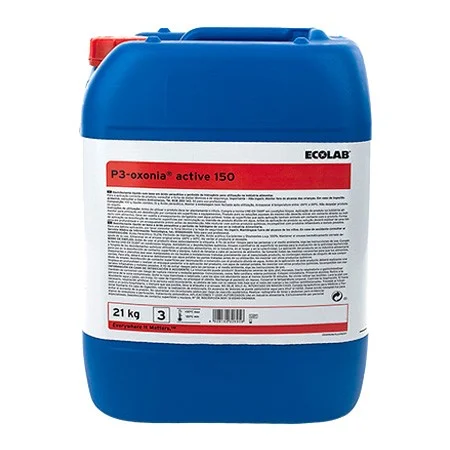
SKU: 2242060 · Brand: Ecolab
- --Ecolab P3-Oxonia Active 150-- is a highly acidic professional disinfectant designed for the preventive disinfection, as well as the combined cleaning and disinfection, of any type of equipment, utensils, containers, and surfaces of production areas made from any material approved for use in the food industry.
- --P3-Oxonia Active 150-- disinfectant is a clear, colorless liquid with a characteristic odor, containing 15% peracetic acid and 18% hydrogen peroxide as active ingredients, along with auxiliary components . The product mixes readily with water; the pH of a 1% aqueous solution is 2.6-2.8. Density at 20°C: 1.120-1.140 g/cm³. The product has antimicrobial activity against gram-negative and gram-positive bacteria, including coliform bacteria, staphylococci, streptococci, and salmonella.
- --Main Applications of P3-Oxonia Active 150:--
- • for disinfecting equipment, utensils, containers, and production premises at wine, beer, soft drink, and mineral water producers; in the fish processing industry; in meat, dairy, and poultry processing; in veterinary services; as well as for washing and disinfecting eggs.
- --Application Notes for P3-Oxonia Active 150:--
- • Cross-check with the hygiene plan and review the product label and safety data sheet.
- • Do not mix P3-Oxonia Active 150 with other products.
- • Does not foam; suitable for use in CIP systems.
- • Always use the product in accordance with the instructions approved by the relevant health authority.
- • Shelf life: 12 months from the date of manufacture. Aqueous solutions remain stable for 3 days.
- --Instructions for Using P3-Oxonia Active 150 for Combined Egg Washing and Disinfection:--
- • Eggs with soiled shells are placed in crates, plastic trays, or other containers on racks within a tank.
- • Dilute 30 ml of the product in 10 liters of water at a temperature of 25-30°C.
- • Egg soaking time: 5 minutes.
- • Remove the egg containers and rinse with water for 10 seconds, then place on slatted racks for 15-20 minutes to allow water to drain.
- • The working solution for egg disinfection is used only once.